Back in October, DC Mud reported that the Historic Preservation Review Board gave a thumbs-up to developer Giorgio Furioso's plans to contruct a six story, 55,000 sf office building along 14th Street, in the vacant lot between Posto and the Great Wall restaurant. According to the poposal the building, which will extend across part of the building which houses Posto and the art galleries Curator's Office and Hemphill Fine Arts.

However, at the February ANC2F meeting, Furioso encountered some pushback from residents of Kingman Place, whose homes run behind the proposed site.
As noted in the Dupont Current, Furioso was at the ANC meeting to seek support for several zoning variances that he is requesting. Among them is a request to have cars who wish to park in a 12 unit garage underneath the building enter through an alley entrance. Kingman Place residents appeared to have two complaints about this proposal:
The first issue is that the volume is spaces is too low, and that office tenants ill instead park on nearby residential streets, taking up valuable parking spaces. Due to the daytime residential parking restrictions in place, this does not appear to be a matter of significant concern. After all, one cannot park for more than two hours without an appropriate residential parking permit.
The second issue is that the volume of spaces, and the cars it would attract, is too great, leading to additional congestion in the alley behind the building. I might be inclined to be more sympathetic to this argument if the projected volume of the parking garage was higher--say, 30 or 40 spaces, rather than 12. After all, it can't be ignored that people who purchased homes on Kingman did so knowing that the rear of their property abutted a commercial corridor.
These complaints may be viewed as being in opposition to each other (too many spaces vs. not enough), but I don't necessarily think that they are. Ultimately, I think the resdient's parking concerns can be summed up as being opposed to anything that would bring additional cars to the alley or to their street.
However, what is apparent is that certain residents of Kingman Place aren't particularly amenable to seeing this project built, particularly if it involves adding more of the dreaded "t" word to the neighborhood. (t = traffic) And thus, we find ourselves basically where every proposed project ends up at some point: opposed by a small group of residents who simply don't want to see the project go up, for varying reasons.
The ANC decided to take no action at the February meeting, meaning that action will be postponed until at least the March meeting. There is no requirement in place that the Board of Zoning Adjustment follow the advice of the ANC, but by District law ANC opinions must be given "great weight"--meaning that a vote by the ANC to not support the proposed parking plan could be a potential setback for Furioso's plans.
There's no anticipated groundbreaking date yet for the project, which requires BZA approval before it can go forward.
Wednesday, February 16, 2011
Trouble brewing for 14th Street office project?

Tuesday, April 13, 2010
Agencies Push to Loosen Restrictions on Bars/Restaurants
Last week, as reported here and elsewhere, DCRA Zoning Administrator Matt Le Grant issued a letter stating that his office would no longer approve occupancy permits for bars and restaurants along the 14th and U Street corridors, in what is known as the Arts Overlay District. 
The announcement came at the conclusion of a study by DCRA that showed that the percentage of street-facing retail along 14th and U streets that is devoted to bars and restaurants was just under the 25% threshold permitted under the current Arts Ovelray restrictions. Enforcement of the rule had been advocated by a small group of neighborhood activists, including ANC1B commissioner Peter Raia and ANC2B commission Ramon Estrada, among others.
As expected, the announcement touched off the proverbial firestorm of controversy, both from within and outside of the area. Seeking to quell the anger, as well as to ensure that the decision posed as little threat as possible to the ongoing development and growth of the neighborhood, it was announced today that the DC Office of Planning would submit a set of recommendations to the Zoning Commission by April 26 to raise the allowable percentage of bars and restaurants to between 40-50%.
The 40-50% amount was the amount recommended by the Arts Overlay Committee in its report delivered last year. (Full disclosure: I served on the Committee.)
Once delivered, the Zoning Commission will vote on the measure at their next hearing, in either late May or early June. If adopted, the new rule would go into effect in late June or early July.
The move is clearly a response to the community outcry that arose after DCRA's statement last week. Although the statement merely indicated a willingness on the part of DCRA to enforce an existing law, the move was seen largely as a response to advocacy on the part of commissioners Raia and Estrada, along with other neighborhood activists, who had sought to have the so-called "25% rule" strictly enforced.
By moving so swiftly to change the law, and thus negate the potential effects of its enforcement, DC agencies seemed to be in agreement with nearly everyone throughout the 14th and U street area that the 25% rule was, in fact, outdated and needed to be revised.
Astute observers will note that, even with this action by the Office of Planning, there is still potentially a three month window during which occupancy permits could be denied to otherwise deserving businesses along the corridor. In response to this, local ANCs--including ANC2F--are moving to ensure that the move has minimal impact on the neighborhood.
"Our neighborhood is open for business," said ANC2F chairman Charles Reed in a press release issued today. "ANC-2F will do everything in its power to assist in speeding community acceptable license applications through the BZA process."
While nothing is certain--the Zoning Commission could, in fact, reject the recommendation--in a city where change seems to come at a glacial pace, it is refreshing to see agencies moving so quickly to address this concern.
Thursday, September 10, 2009
Lessons From Cleveland Park
This morning, the Washington Post ran a story about Cleveland Park's disappearing retailers. Never known as a commercial and retail hotspot, it seems that retailers are closing down at a rate that is alarming the neighborhood residents.
Several factors were blamed as culprits, but a couple of them should sound familiar to neighborhood residents who have been following neighborhood developments around 14th and U streets recently: a lack of parking, and a zoning regulation that restricts bars and restaurants to no more than 25% of the linear retail frontage in the neighborhood. Unlike along 14th Street however, in Cleveland Park the restriction is actually followed and enforced.
As the ARTS Overlay District Committee recently concluded, shifting retail demographics mean that it's no longer reasonable to reserve 75% of retail frontage for non-restaurants and bars. The Committee's recommendations included raising the allowable limit of bars and restaurants to 40-50%.
In Cleveland Park however, the citizen's association has been adamant that the restriction not be raised, setting up a showdown between the entrenched Association leadership and a group of citizens who would like to see the restrictions relaxed and other initiatives advanced to encourage development in the neighborhood. Keep in mind, this is the same neighborhood that engaged in a ten year battle with Giant over a new Giant store and mixed-use development along busy Wisconsin Ave.--at the location of an existing Giant store.
What's happening in Cleveland Park is an example of what can happen when zoning laws do not adapt to a changing retail environment. How might this apply to 14th Street?
Unlike Connecticut Avenue, 14th street is not fully built-out, so the issue of vacant buildings is not a good comparison. A more likely scenario is that the vacant storefronts along 14th street become banks, pharmacies, real estate offices and other uses that do not enhance the street-level activity. (One such plan is in the works at a prominent 14th street intersection in Logan--more on that in a later post).
In other words, when development is unnaturally restricted, there is a risk that undesirable results may arise.
Everyone can agree that a vibrant, mixed-use corridor along 14th and U streets is within everyone's interest. But this vision should be tempered with a pragmatic approach to the current retail market. Personally, I would love to see more art galleries, bookstores and independent boutiques up and down 14th Street. The changing retail market however tells us that such a vision is unlikely to come to fruition without some assistance and changes to DC zoning laws. This means more vacant storefronts that must be filled, and the question becomes "with what?"
With a de facto moratorium in place restricting bars and restaurants--which are, in effect, the only local businesses thriving in this market--the answer is more chain retailers and the aforementioned banks and pharmacies. Some may argue, directly or indirectly, that this is an acceptable course for the neighborhood to take in order to maintain a "mix" of retail in the neighborhood that does not include more eating and drinking establishments. This blogger is not among them.
Reversing this course, and ensuring that 14th street remains a vibrant, attractive home for a variety of new businesses, will require some changes. Many of these--including the recommendation for raising the allowable limit of bars and restaurants--are included in the report recently released by the ARTS Overlay Committee, which has now been heartily endorsed by all three area ANCs as well as numerous neighborhood associations.
What's happening in Cleveland Park serves to highlight the importance of ensuring that zoning regulations work to benefit--not hinder--development and progress in a neighborhood.
Tuesday, September 1, 2009
Shaping the Future of 14th Street, Part 2
Can we keep the "arts" in the ARTS Overlay?
That was the predominant question put before the ARTS Overlay Committee this summer. What follows is a brief preview of the Committee's report, to be unveiled at tomorrow evening's ANC2F meeting. First, a little background. The Committee (which, in the interests of full disclosure, I was a member of) was created in order to provide a set of recommendations to the DC zoning regulations that govern the Overlay district. The Committee included a mix of new and longtime neighborhood residents, business owners--and one developer--and held a series of public meetings over the summer, where they discussed the current state of the District, and what could be done to help preserve (and attract) arts uses for years to come.
While the ARTS Overlay restrictions maintain some rather esoteric regulations governing things like bonus density and FAR allowances, their most notorious feature is the 25% restriction on the amount of bars and restaurants (as measured in linear feet). Our findings were that a) the restrictions are not working, as no DC agency is even tracking the amount of frontage currently taken by bars and restaurants (it's currently estimated to be around 29%), and b) 25% is too low a figure, as it doesn't properly reflect the changing nature of the neighborhood.
Also atop the Committee's lit of things to address was the reality that the neighborhood stands to lose some of its arts-related establishments. At several public meetings, we heard from proprietors of galleries, and landlords who had arts tenants, explain that economics were pushing them out of the neighborhood. It seems that while everyone claims to love the arts element in our neighborhood, and the city likes to promote their existence, very little is being done to ensure that they can remain here.
Thus the Committee's task was set: make recommendations to the city's zoning code that encourages arts uses in the neighborhood and helps ensure that once they are brought it they remain, while also seeking to ensure that the 14th and U Street corridors remain vibrant streets filled with a healthy mix of retail and entertainment options.
Though specifics for each of the recommendations in the Committee's final report won't be announced until tomorrow evening, I can tell you some generalities of what will be included, such as:
In addition, we determined that one of the things we could do to economically aid artists, retail businesses and even restaurants would be to look for ways to encourage daytime traffic in the neighborhood, something that is covered under another set of the Committee's recommendations.
Ultimately, the Committee's report will need to go through several stages of review, before ending up in the DC Office of Planning, which will then need to determine whether or not to accept them.
Undoubtedly, the 14th/U Street areas have been transformed during the last several years. However, there is still a significant opportunity for change in the neighborhood, and the decisions that are made today may very well have an affect on the corridor 20-30 years from now. If you're interested to learn more, plan to attend tomorrow evening's ANC2F meeting. Or, you can visit the ARTS Overlay Committee's website, located at http://www.blogger.com/www.anc2f.org/arts.
Sunday, May 24, 2009
What Could DC Learn From London?
All images by Mr. 14thandyou
Happy Memorial Day everyone! Here's a post we've been working on for some time, and the three day weekend provided us with enough time to get it finished...
********************************************************************
Here at 14thandyou, we don't exactly take great pains to disguise the fact that we think DC is a pretty fabulous place to be. Our city is beautiful, the cultural opportunities are immense, the outdoor activities plentiful, the green spaces lovely, the educational institutions outstanding, and--perhaps most importantly-- the dining superb. In short, DC and its environs offers an opportunity for a pretty fantastic quality of life. However, you can't address all of the "good" of the city without also discussing the "bad". You may find DC a great place to be, but it doesn't mean that you can't also remain on a constant vigil for ways in which the city could improve. It wasn't all that long ago, of course, that DC was viewed largely as a cultural backwater, a sleepy southern town more infamous for political follies than for anything the city itself might offer. (The District did not have a world-class performing arts venue until the Kennedy Center was erected in the early 70s, for instance.) It has come a long way in a short period of time.
Not long ago, the 14thandyous returned from a trip to London. Mrs. 14thandyou had spent some time in Britain's capital city during her college years, whereas it was Mr. 14thandyou's first visit. Central London is unquestionably one of the most beautiful, exciting and vibrant cities that the world has to offer. Visitors are welcomed to block after block of Victorian-era homes and gardens, not to mention some of the finest shopping and dining options anywhere. It is truly a magnificent city. It is with this in mind that the 14thandyous returned from our trip with an eye towards some things that DC could adopt from its British counterpart.
On its face, it may seem a bit unfair to compare one of the largest and most culturally sophisticated cities in the world with Washington, DC. To be sure, no one who has ever tired of our traffic, sweltering summers and sometimes-inept local government could ever be said to have "tired of life." And with that position of global prominence comes an equal supply of resources, both financially and otherwise. But that doesn't mean that there aren't lessons that DC could take away from London that would aid in its continued growth and development--lessons that could be implemented here, if so desired.
Relax the Residential/Commercial Zoning Laws
Imagine strolling through the leafy streets of Georgetown, Shaw, Capitol Hill or other DC neighborhoods. Rather than having commercial corridors expressly laid out along only a handful of specific streets and blocks, picture those shops, restaurants and other businesses interspersed within residential areas. Impossible to imagine in DC? Most likely, but it's something that you encounter frequently within even the toniest areas of London. In the middle of Chelsea, which contains some of the most expensive real estate in the world, you'll find commercial strips lined with pubs, restaurants, supermarkets, bookstores, homewares and more. It's not considered scandalous to locate a pub at the corner of an otherwise residential street. It creates a far more vibrant neighborhood, and not to the detriment of the people living there.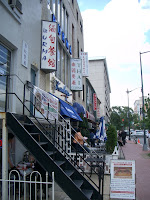 In DC, zoning laws make that idea prohibitive, and what the zoning laws don't cover ANC and neighborhood groups do in their zealousness to protect residents from interspersing residences with commercial activity. This isn't a call for unfettered development everywhere in the District mind you, but rather a call for a more sensible adoption of DC zoning laws--as well as local neighborhood opinion--that would ease the nearly complete prohibition of commercial development in otherwise residential sectors. This type of zoning leads to vast swaths of blighted commercial corridors (found in certain central DC neighborhoods) and contributes towards more residential neighborhoods being underserved by commercial activity. Finally, such development also encourages cohesiveness and a greater sense of community within neighborhoods, where the corner cafe or market down the street becomes an additional focal point to residents of the neighborhood.
Encourage Density
This is certainly a highly charged topic and one that could be debated ad nauseum, so I'll try to keep this particular point focused on one particular issue: encouraging development around Metro stations, both within the District and in the surrounding areas as well. Within London, clustered development around Tube stations is found all around the central city, meaning that where one finds a subway station in London, one will also likely find all manner of shops, retailers, restaurants, etc. This not only encourages smart growth land use patterns, it also leads to more walkable, cohesive neighborhoods. DC has started to make real inroads with this type of development. Around certain parts of downtown (Penn Quarter, Farragut Square) as well as the Orange Line corridor and certain parts of Montgomery County, dense commercial and retail development is centered around Metro stations. Still, a number of stations are underdeveloped and lacking appropriate levels of density. A good example of this is the U Street station, where plans are in the works to transform two underutilized corners near the station entrance into significantly denser developments more befitting of their location. This type of development is a boon for the city, as well as for residents and visitors alike, and should continue to be encouraged.
Keep the Streets Clean
London is a remarkably clean city, and I don't even need to add the caveat "for its size". It's just clean, period. Some of that is no doubt cultural. There seems to be a greater amount of respect given to public spaces in London, in that littering is greatly frowned upon (and thus largely not practiced.) But that's only part of the explanation for why London's streets are by and large free of refuse and other debris. The city employs individuals who patrol the streets on a regular basis and sweep up the trash that accumulates. These individuals don't merely patrol the most popular and visible thoroughfares, you'll see them throughout the city, sweeping up everything in their wake. If you spend any time in central DC, you've probably seen those downtown BID employees (the ones wearing red jackets) who are stationed near Metro stations and busy tourist areas to assist tourists with directions, transportation questions and other issues. They're a great idea, but why not expand their responsibilities to street sweeping? Additionally, the city could work through the ANCs and neighborhood associations to employ individuals in neighborhoods outside of the Mall and central business district to keep the streets swept and maintained. It's surprising how something so relatively minor can go a long way in improving the quality of life in a city.
Also, the District could look to end its practice of refusing to place trash cans along residential blocks that receive significant amounts of litter. One finds trash cans throughout London--including the residential areas--and the city's trash and litter problem seems none the worse for wear.
Maintain Your Green Spaces
My, but aren't London's parks gorgeous? The lawns are lush and green, the walkways well-maintained, the ponds and lakes clean and largely free of debris. Contrasted with DC's parks and green spaces--including the National Mall--London's are simply in better shape. Why the focus on parks, you may ask? Parks are among the most valuable assets that a community and a city has. They're beautiful places that all can enjoy, and provide much-needed solace from the urban roar surrounding them. As a Logan resident, I love having places like Logan, Thomas and Dupont circles nearby for strolling and relaxing. In addition, the amount of investment, financially and otherwise, that a city invests in its park system speaks to a city's character.

Now, I know that one of the biggest strikes against this idea, as far as DC is concerned, is that a number of our parks--including the Mall, Rock Creek, all traffic circles and the downtown squares--are maintained by the NPS. But there is nothing preventing the District from seeking a partnership with NPS that would allow the two to work together to keep our city's parks free of trash and other debris. In the long term, this also means lobbying strongly for the federal funds needed to rehabilitate the Mall and other downtown DC parks. Places such as Franklin Square and McPherson could be lovely oases of urban tranquility if spruced-up and properly maintained. The amount of greenspace that DC has trumps that of many other American cities; so the groundwork has already been laid.
Continue Investment in Public Transportation and Infrastructure
One of the positive aspects of DC that people remark upon visiting our city is the public transportation options available. The Metro does a reasonable job of covering the DC region, while the bus system, Circulator, forthcoming streetcar lines and programs such as SmartBike serve to fill in the gaps. This is unquestionably a very positive aspect of our city, but some perspective is in order. The Metro is a great system, but there are numerous people within the city and the area for whom commuting via Metro isn't an option. Even within the denser, more heavily served central part of the city, some areas are not as well-served by Metro as they should be, and getting from some destinations to others is unnecessarily burdensome.

Contrast Metro with London's tube, and you'll gain an understanding of how a truly extensive public transit system functions. Throughout central London, one is rarely more than a couple of blocks from a station entrance. The sheer volume of lines, coupled with line duplicity along high-volume corridors, means that no two destinations are more than a few minutes' ride away. Additionally, the existence of a central "loop" line means that the disparate lines coming into the central city all converge--in a manner of speaking--onto one centralized line (not unlike Chicago's loop).
What can DC do to continue moving in this direction? To begin, I would suggest a renewed focus on "building out" the core of the Metro system--that is, the section of the system that serves central DC and the close-in Maryland and Virginia communities. Focus on the ongoing development of new intercity lines--particularly a second east-west line that relieves the burden currently handled by the Orange/Blue lines--as well as the creation of in-fill stations along existing lines in underserved areas. The construction of the Purple Line in Montgomery County is another good step forward, but should be developed in concert with a long-term plan to ultimately develop a "loop" line that encircles the core of the region. The creation of additional Circulator lines should be another component to the city's ongoing transportation plans. Using the recently created McPherson Square - Woodley Park line as a model, the Circulator offers the ability to connect neighborhoods in the city that are not served (or poorly served) by Metro. Finally, an increased focus on other transit options, such as the pioneering SmartBike program, should be considered as well.
Lest one think that London has nothing to learn from DC's transit service however, I will posit this: the Tube stops running at a ridiculously early hour. That Metro runs until 3 AM on weekends, and until midnight throughout the remainder of the week, is a tremendous asset to the region--and one that shouldn't be taken lightly.
As I mentioned above, the point of this discussion was not to attempt to compare the two cities, as they exist on completely different levels. Rather, it is meant simply to provoke a discussion on some things--some relatively significant, others quite simple--that the District might do order to continue its ascension to the ranks of truly global--and exceptional--cities. By applying some of the methods and strategies employed by a city regarded as among the finest in the world, the District could continue to make improvements towards becoming a better place for the millions of us who live and work here.
Saturday, April 18, 2009
Is the City Enforcing the Arts Overlay Restrictions?
After a week in London, the 14thandyous returned to DC to discover that the Dupont Current had published a front page story on a subject that is near-and-dear to our hearts: the Arts Overlay District, and specifically its restrictions on the type (and volume) of commercial frontage in the Logan/Shaw area. (It didn't hurt that yours truly was quoted in the article, of course...and thus we reach the limits of our self-promotion.)
We won't rehash the article here, nor go over the finer points of the District's stipulations (for more on that, see our previous post on this issue). However, we did want to bring to light a not-insignificant point raised by the article: no one seems to know whether the District, and specifically the Board of Zoning Appeals (BZA), is actually going to enforce the commercial frontage stipulations. The issue in question relates directly to the retail frontage along certain streets in the area (14th, 7th, 11th, U Street and Florida) and the fact that no more than 25% of this can be restaurants.
JBG Cos., who are developing the old Whitman-Walker building at the corner of 14th and S streets, applied for--and received--an exemption to the 25% barrier in order for them to be able to include a restaurant in their plans for the building. Even more interesting however is the fact that JBG only applied for the exemption as a precaution, because no one knows for certain whether or not the 25% has been hit (it seems in all likelihood that it has, but no definitive numbers exist) and, more basically, no one has defined what constitutes "retail frontage". If nothing else, it seems that running afoul of the Overlay District's regulations is not a matter of grave concern for those seeking to develop properties in the area (witness the two new restaurants/lounges coming soon to 14th street, and the recently opened Policy, as other examples.)
All of which begs the question: if no one is paying attention, and desire to enforce the regulations is lacking, then why not take them off the books completely? By remaining in force (officially) the Overlay District restrictions present, if nothing else, a potential grounds for protest to future developments, which would be unfortunate.
Greater Greater Washington blogger David Alpert is also quoted in the Current's piece, and I happen to agree with his sentiments: the intentions behind the Overlay District's restrictions are noble, but the execution is flawed. We can only hope that this archaic set of guidelines is dispatched--or, at the very least, comprehensively rewritten--before an adverse impact upon the future development and growth of the neighborhood is seen.
Tuesday, December 11, 2007
One Step Closer to a Better Giant
Up until now I never really paid attention to the Zoning Commission. Some of its more newsworthy decisions seemed to me to be nonsensical, but of little personal consequence. The O Street Market situation casused me to look into the ZC a little more. According to their website, "The Zoning Commission is an independent, five-member, quasi-judicial body in the District of Columbia . . . . Three members of the ZC are residents of the District of Columbia appointed by the Mayor and confirmed by the Council." (I'm really not quite sure what "quasi-judicial" means as compared to "judicial".) Last night the chairman of the Commission stated that as judicial body it was inappropriate for anyone to lobby the Commission. Nevertheless, I feel that when the ZC is acting against the wishes of the mayor, neighborhood residents, and ANC commissioners, they need to know it. The ZC is basically self-regulating, so for development projects that do not meet criteria for Board of Zoning Appeals review, the ZC is the only body that can make judgment calls. Without resident and elected official's input, how can we check the power of the ZC to ensure that their decisions really are consistent with the regs and that exceptions to regs are granted when appropriate (and only when appropriate)?
By the by, the ZC has embarked on a comprehensive rewrite of the city's zoning laws. ANC 2F Chairman Charles Reed is lobbying for the ANCs to have input in this process, and hopes to form a committee of 2F residents. Given the impact that the law rewrite could have on DC, I would argue that this is a far more important and sexy issue than it sounds to be. A lot of great developments and sensible home improvements have been blocked by current zoning laws while a whole lot of awful projects made it through the filter. More of my thoughts on this matter to come soon . . .
Tuesday, November 27, 2007
More on O Street Market
Roadside Development unveiled its plans for the O Street Market/Giant complex to ANC 2F during the August CDC meeting. The meeting was well attended, and I don't recall a single negative comment about the proposed development. In fact, folks seem to be very excited about the rehab of that lot and plans for other residential and retail development in the area.
However, the Zoning Commission is determined not to approve the Roadside's current design despite overwhelming support from ANC 2C and ANC 2F residents, council members , ANC commissioners, and Mayor Fenty. The Zoning Commission objects to the building height and the high density of development. Many worry that the Zoning Comission's desired changes will limit Roadsides's ability to include extensive parking -- necessary to serve new condo residents, grocery shoppers, and retail customers in this complex.
The Zoning Commission does not provide for citizen testimony of any sort. As we already have the support of our elected representation, there really aren't too many more public figures to appeal to regarding this matter. Our last opportunity to influence the proceedings will be the Zoning Commission meeting at 6:30 p.m. on Monday, December 10 (directions here). Showing our support with a large physical presence is key for impressing upon officials how important this matter is to us.
Tuesday, October 30, 2007
O Street Market Update
At the end of my Friday post I mentioned that the O Street Market plans may have hit a hitch. Thanks to Kevin Chapple's ANC2CO2 Forum for reporting on the zoning board meeting for this project. The board's major hang-up seems to be that the current O Street Market plans call for structures as high as 110 ft. and a higher building density than the surrounding area. Despite Fenty's support for Roadside Development's construction plans, the zoning board is requiring that the developer either re-draft its plans or come up with further justification for a height variance. Apparently there is concern that the planned redevelopment would be out of character for the neighborhood. Hmmm, out of character for a neighborhood that already has the convention center? Anyway, the ANC2CO2 Forum post and comments do a much better job than I could outlining the issues. Seems like the DC gov't. is once again out of line with what many residents and ANC commissioners want for their neighborhoods.
Thursday, September 27, 2007
CDC and ANC News
Last night's CDC meeting was a bit of a snoozer. Aside from two homeowners requesting the ANC's blessing for a carport on their property, there wasn't too much going on. In fact, Mr. 14th & You and I were the only other members of the audience.
The most interesting information came in a conversation with Mike Bernardo after the meeting. We discovered that the McCormick Paints lot on the corner of P and 15th Streets will become . . . condos. Yes, more condos for the 1400 block of P. The plans are not, however, a sure bet; a recent zoning change has hampered the original design.
We also learned the reason why the condo building construction at the opposite corner of P Street has been moving at a snail's pace. A discovery of a well under the property created some issues that halted construction for about a year.
In other less interesting news, Mike Bernardo is now heading the CDC. Though Dyer remains on the ANC, he has resigned his position heading up the CDC. Also Commissioner Reed has recommended petitioning the Council to allow ANC input into upcoming city-wide zoning changes. Though the changes are not anticipated to substantially affect commercial or residential zoning, Reed would like to have CDC committee involved in the review.
The agenda for the ANC 2F meeting next week was released today. It is as follows:
- ANC 2F05 Commissioner Election
- ANC 2F Crime and Public Safety Committee Report
- A monthly report from Executive Office of the Mayor
- DDOT's monthly Report
- A Voluntary Agreement Modification for Stoney's, 1433 P Street, NW
- A Voluntary Agreement Modification for Mar de Plata, 1410 14th
Street, NW (10-seat sidewalk café)
- A Voluntary Agreement Modification for Logan Tavern, 1423 P Street,
NW (add 46 seats inside and 14-16 outside to café)
- A Substantial Change in Liquor License for El Sauce Restaurant, 1227
11th (from DR to CR license)
- Hot Spot No Loitering Zone Amendment Act, 2007 Bill #17-111
- Trash Collection at 1107 11th Street, NW
We're happy to see that the Stoney's issue will finally be resolved.
Random note: Have you noticed the large ads for Universal Gear on the east side of the 1500 block of 14th Street? Anyone know if this is an additional location or a wholesale move of the store on 17th Street? I guess it's good that we're getting some non furniture retail between P and U.