Here's a couple of news items to pass along:
Azi's Cafe in Shaw is getting a new owner. (Initial reports that it was closing ended up not being correct.) Azi, the owner, sold the business--but the coffee shop/cafe concept will remain. It's unclear whether the name will remain the same, since Azi will no longer be involved--although for now that seems to be the case.

Those of you who have been in tne neighborhood longer than a couple of years will remember Azi's as one of the businesses that contributed towards changing perceptions of Shaw. While the always-smiling Azi will be missed, it's great that the coffee shop will remain.
In other not-so-good news, 14th Street is losing another one of its galleries. From Borderstan, Irvine Contemporary gallery owner Martin Irvine has announced that he will be relocating his gallery from 14th Street to an as-yet-undisclosed location. The gallery will close following the closing of the Artist Tribute Exhibition show, which is set to open on July 23.
The closing of Irvine represents yet another blow to the 14th Street arts scene, which in the past couple of years has also seen the loss of the Randall Scott Gallery and G Fine Arts. Other arts-related businesses--such as jazz club HR-57--have also left the neighborhood in search of cheaper rents elsewhere. And while the ANC2F arts overlay committee made recommendations two years ago for steps the city could take to help retain arts-related businesses in the neighborhood, few tangible results have come out of it aside from last year's controversial banner campaign.
Tuesday, June 7, 2011
Neighborhood news: Irvine Contemporary to close, Azi's gets a new owner

Thursday, October 14, 2010
Two Deadlines Upcoming in Arts District Branding Initiative
As the initiative to brand the "arts district" (the area bordered by 16th Street, Florida, U Street, 7th and Massachusetts) continues, two deadlines are quickly approaching--one this week, and one next week.
If you are an area artist and would like to have your work considered for use as one of the street graphics (i.e. banners) that will appear throughout the district, the deadline for submission of artwork is tomorrow, October 15.
The competition is open to artists throughout the city. Judging for the winning submissions will be completed by November 3, winning entries will be on display throughout the area by November 7th, and the banners will be installed by December 1 - in time for the holiday shopping season. More info can be found on the Arts District blog, DCArtsDistrict.blogspot.com.
The second deadline pertains to the naming of the district. If you have attended any of the arts district public meetings, you know that the subject of the name of the district has been a point of much discussion. Until October 22, everyone will have the opportunity to submit his or her choice for the name of the district. Simply go to DCArtsDistrict.blogspot.com and register your favorite name there. The winning name will be announced shortly thereafter.
If you're looking for additional background information on the arts district project, you may view the ANC2f Arts Overlay Committee report here, or read our previous posts on the topic here.
Sunday, September 12, 2010
Third Arts District Branding Public Meeting Monday @ Jewish Community Center
The third public meeting regarding the branding and marketing of the so-called Mid-City Arts District will take place tomorrow (Monday) at 6 7:30 pm at Theater J in the Jewish Community Center, located at 16th and Q streets NW. Among the items up for discussion include:
-What do you think are the unique/special characteristics of this district?
-What does "ART" and "ARTS DISTRICT" mean?
-How do you think the district should be named?
-Do the proposed boundaries capture the intensity of the marketable arts assets in this district?
The last point is something that has come up at both prior public meeting; that is, the question of whether the boundaries for the arts district are too large. How, it has been asked, can a singular brand be applied to an are that encapsulates both 7th and M streets and 16th and U?
The simple answer is that it can't. The arts district, as it has been defined, includes a number of neighborhoods with established identities, such as Shaw, Logan Circle, Dupont Circle, U Street and LeDroit Park, among others. Clearly, no single brand can effectively convey the unique attributes of each of those areas. Thus, the arts district should be thought of more as a collection of established neighborhoods--perhaps even a small city--with an overarching identity as a center for the arts and for commerce. Think "U Street in the Arts District", or something similar.
If you have thoughts or opinions to share about this or the other topics listed above, please plan to attend tomorrow evening's meeting and have your voice heard. Participating on the panel will be two executives of the Toronto-based design and branding agency L.A. Inc., who will share their thoughts and perspectives about establishing an identity for and marketing urban neighborhoods.
Additional information about the Mid-City Arts District project can be found on their blog, midcityarts.blogspot.com.
Monday, September 6, 2010
Next Arts District Branding Meeting to Take Place on Tuesday @ Warehouse Theater
Welcome back, everyone. I hope your commute back into the city were painless (if you left, like we did) or that you enjoyed a long weekend around our fair city if you stayed local.
If you're out and about tomorrow evening, I'd urge you to drop in on the next meeting of the Arts District Branding discussion, taking place at the Warehouse Theater from 6p-8p. This is a tremendous opportunity to engage community leaders, artists, business owners and are organizations in a discussion about how to brand and market what is currently termed the Mid-City Arts District. The decisions that come out of these meeting will ultimately have a substantial impact on the marketing of the neighborhood to city residents and tourists alike, and will thus impact the arts organizations, artists, businesses and residents of the neighborhood.
If you missed the first meeting last week, Borderstan has a great recap of the event. The agenda for tomorrow evening's presentation can be found below. For more information, please visit http://midcityarts.blogspot.com.
Presentations & Street Graphics Competition Update:
6:00 PM - 6:45 PM:
-Welcome by Co-Hosts Alex Padro / Paul Ruppert
-Welcome and project overview by Andrea Doughty, Project Coordinator
-What do we mean by “Branding and Marketing an Arts District?” by Carol Felix, Lead Branding Consultant
-Update on the Streets Graphics Competition by Carol Felix
Dynamic Panel Discussion:
6:45PM- 7:30 PM:
-Jennifer Cover Payne: President, Cultural Alliance of Greater Washington
-Paul Ruppert, Producing Director, Warehouse Theater
-Alex Padro: Executive Director, Shaw Main Streets
-Myla Moss: Board of Directors, Howard Theater Restoration
-Martin Moulton: President, Convention Center Community Association
-Gerry Widdicombe: Director of Economic Development, Downtown DC B.I.D.
Public Dialogue, Questions:
7:30 PM- 8:00 PM:
-Michael Altman, Facilitator
-Andrea Doughty, Project Coordinator
Tuesday, August 3, 2010
This Weekend: Dog Days Celebration
With temps consistently in the 90s and the humidity making a trip down the street feel like a walk through a bowl of split pea soup, what better time to celebrate the "dog days" of August? (BTW, I was curious as to what "dog days" meant, because it always seemed an absolutely bizarre phrase to me. According to my good friend Wikipedia, the term "dog days" traces its roots to Roman times. The Roman people associated hot weather with the star Sirius, or "the dog star". Hence, the hottest, most sweltering days of the year are called the "dog days". At least MY curiosity is satisfied...)
Here in Logan, the term "dog days" takes on a slightly different meaning: the 11th annual Dog Days Event, where shops, restaurants and entertainment venues throughout the neighborhood entice shoppers and diners with special deals, and sidewalk entertainment and other special events are ongoing throughout the neighborhood.
As I'm certain that many of our readership consider themselves to be champions of local businesses, weekends like the one upcoming are critical to their success in the neighborhood...so if there's a gift you've been holding off on buying, or a new restaurant you've been wanting to try, this is a great weekend to do it. Rather than simply parroting what Dog Days sponsor Mid-City Business Association has to say about it, I'll just copy the text of their email below. The 14thandYous plan to be out and about, and we hope to see you out as well. Stay cool!
DOG DAYS OF AUGUST RETURNS TO WASHINGTON
DC's Coolest Downtown Neighborhood Hosts the
Hottest End-of-Summer Weekend Event August 7 and 8
Dog Days of August, the annual cultural event which brings together over 100 stores, boutiques, restaurants and art galleries in one of Washington's most celebrated neighborhoods, announces their 11th annual event on Saturday and Sunday, August 7 and 8. The weekend will feature special events, sales, family events and restaurant deals throughout the 14th and U Street (MidCity) corridors, which comprises the area up 14th Street from Belmont Street to Thomas Circle and just off U Street from 9th to 17th Street.
The weekend is anchored by arts events including The Studio Theatre Prop & Costume Sale, the highly anticipated annual sell-off from the 2009-2010 season. In addition, meet local artists and performers at Source and join Cultural Development Corporation and Source resident organizations for family events including improv, step, and light saber workshops for all ages as well as a free showcase performance of the upcoming year at Source.
On the fashion front, independent clothing boutiques including Redeem, Nana, Junction, Lettie Gooch and Treasury Vintage will feature sales of up to 70% off on current season designer clothing and accessories as well as other sidewalk specials. Home furnishing and design shops including Urban Essentials and RCKNDY will be holding floor sample sales featuring discounts of up to 80% off throughout the Dog Days weekend. For a list of stores and offers to date click here.
Cork Market, the accompanying shop to 2010 RAMMY award winner Cork Wine Bar, will stage a donut and lemonade stand on 14th Street as well as a wine tasting and discounts throughout the store. ACKC Cocoa Bar will be hosting a tropical beach party throughout the weekend, while many of MidCity's other heralded restaurants, including Marvin, Busboys & Poets, CakeLove, Saint Ex, 1905, Rice and Policy will be offering patrons Dog Days specials on food and libations. MidCity is home to three 2010 RAMMY award winning restaurants, including Birch & Barley (winner, Best New Restaurant) and Churchkey (Hottest Restaurant Bar Scene) and Cork Wine Bar (Best Neighborhood Gathering Place).
In addition to the great sales, Dog Days will also feature art and cultural exhibits and performances from Sukio Design Co., The Joan Hisaoka Healing Arts Gallery, and Twins Jazz Club.
"Dog Days showcases the incredibly vibrant destination MidCity has become," says Natalie Avery, Executive Director of the MidCity Business Association. "It brings together all of the best things about the area in one weekend. For localresidents it's a yearly tradition. For visitors, it's a great weekend to get to know one of DC's most unique, thriving, and historically rich districts." The MidCity district is home to many of Washington's most historical and wellknown cultural landmarks, such as Ben's Chili Bowl, the Lincoln Theatre and the Taylor Motors Building that is now home to neighborhood newcomer Room & Board.
Saturday, June 12, 2010
ARTS Overlay News: 50% Cap Appears Set for Passage
Yesterday, the Zoning Commission met to hear testimony regarding the permanent raising of the cap on bars and restaurants to 50% in the Uptown Arts Overlay District, which includes substantial portions of U Street and 14th Street.
There had been some speculation as to who might show up to oppose the measure--after all, last week ANC2B commissioner Ramon Estrada had written a letter on behalf of the ANC's Zoning and Historic Preservation Committee expressing opposition to the matter. Estrada, however, was nowhere to be found at yesterday's meeting, and in fact ANC2B voted unanimously at their last meeting to support the recommendations of the ANC2F Arts Overlay Committee to raise the cap on bars and restaurants to 50% of retail frontage.
The measure seems set to pass in spite of some concerns related to increased traffic and noise in the neighborhood brought on by the density of restaurants and bars. For various reasons, the oft-made comparisons to Adams-Morgan aren't really applicable for 14th or U Street--even though the neighborhood is quickly becoming one of DC's preeminent drinking and dining destinations. As to the concerns about parking, well, we're somewhat sympathetic, but with Metro, the Circulator, buses and taxis...why would you drive? (Yes, I'm talking to you, guy from Virginia who can't seem to figure out DC's grid layout and takes 20 minutes to park in a space the size of a mobile home.)
Still, there is a recognition that holding back 70-75% of retail frontage for non-food and drink-serving establishments is too high, particularly in the current environment. As local broker Blake Dickson stated at the meeting, "today in our market, the only thing working is food and beverage."
Thus, with no real opposition, and strong community support for the measure, it seems that one of the most critical issues needed to ensure the continued growth of the 14th and U Street corridors will move forward. The Zoning Commission will meet on June 28 for a final vote on the measure, which barring some unforeseen developments, appears all but assured of passing.
Wednesday, April 28, 2010
Zoning Commission Takes Emergency Action: Bar/Restaurant Cap to be Raised
I am a bit late in posting this, but I did want to pass along the news that, at their meeting on Monday, the Zoning Commission decided to take emergency action to address the controversy that has erupted regarding the future of bars and restaurants in the area.
The Commission voted to expand the allowable percentage of linear frontage along 14th and U streets in the Arts Overlay District to 30%, up from 25%. The action goes into effect immediately and will last for 120 days, meaning that no businesses should see their operations or planned development disrupted by this issue.
At its June meeting, the Commission is expected to take up the issue of permanently raising the cap on bars and restaurants along the corridor to 50%, which was the recommendation provided by the Office of Planning in their letter sent last week to the Commission.
So, in sum: stop freaking out. We're cool here--more tapas is on the way.
Monday, April 19, 2010
The "25% Rule": Clearing Up Some Misconceptions
Ever since the announcement from DCRA's zoning administrator a couple of weeks ago that no more certificate of occupancy permits would be issued for bars or restaurants along 14th and U Streets, there has been a lot of uproar--and confusion--about what it means and how it will affect the neighborhood going forward.
That's understandable, as there has been a lot of confusing information (and hyperbole) being tossed around. Yet while individuals are of course going to continue to draw their own conclusions about what motivated the announcement, and what effect it might have, I wanted to at least attempt to clear up some of the misconceptions or confusion that surrounds this issue.
Q. Why did DCRA choose to make the ruling now?
A. Simple answer: because the so-called "25% cap" on bars and restaurants was about to be hit, and DCRA would be violating established DC zoning law by continuing to approve CofO permits for bars and restaurants that would cause the cap to be exceeded. Until fairly recently, no definitive study existed as to what percentage of street level retail frontage throughout the Arts Overlay District consisted of bar or restaurant operations. DCRA recently completed such a study, and found that the percentage was just a shade under 25%--meaning that any more bars or restaurants would exceed the cap. Thus, the recent ruling from the Zoning Administrator.
Q. Did DCRA thwart the recommendations of the Arts Overlay Review Committee in its recent declaration?
A. Absolutely not. In fact, DCRA was merely doing what the Arts Overlay Committee had requested it do: namely, conduct an assessment of the makeup of the retail market throughout the Arts Overlay District, and enforce the law accordingly. No one advocated that DCRA ignore the law and continue approving CofO permits in violation of the zoning code. It's important to understand that DCRA does not have the power to alter the zoning code; they can merely enforce it.
At worst, DCRA could be accused of being negligent on the PR front, via the issuance of a letter that seemed to ring the death knell for restaurants and bars along 14th and U streets. But nothing in DCRA's actions precludes the adoption of the Arts Overlay Committee's recommendations; in fact, one might argue that the statement hastened their consideration.
Q. Does DCRA's ruling mean the end of bars and restaurants along 14th Street and U Street?
A. Hardly. To begin, DCRA's statement has no affect on any bars or restaurants currently in operation, or those that are planned and have already received their CofO permit. Those that have NOT yet received their CofO may apply for an exemption through the Board of Zoning Appeals (BZA), who have traditionally been lenient with approving zoning exemptions for businesses along the 14th and U Street corridors.
Secondly, this past Thursday, the Office of Planning submitted a letter to the Zoning Commission formally requesting adoption of certain recommendations put forth by the Arts overlay Committee; specifically, those recommendations that dealt specifically with raising the cap on bars and restaurants to 50% of street level retail frontage. The letter requested that the Zoning Commission consider the issue under an emergency basis at their April 26 meeting (since certain proposed establishments stand to be affected by the ruling). Failure to do so would mean that the measure would move forward as a regular amendment and would become effective by the end of July.
Q. I've heard quotes from community leaders that the popular sentiment is that most in the neighborhood do not want additional bars and restaurants. Is this true?
A. While no one has gone door-to-door polling this question, it is safe to say that quite the opposite is true. When the Arts Overlay Committee presented their recommendations for changes to the Arts Overlay restrictions--including raising the allowable cap on bars and restaurants to up to 50%--they were supported nearly unanimously by all three area ANCs (1B, 2B and 2F) as well as by several area neighborhood associations. During the course of the Committee's public meetings throughout the summer of 2009, comments and testimony were virtually unanimous in support of allowing more restaurants and bars into the neighborhood. There is a recognition amongst most members of the community--leaders, business owners and residents--that such establishments have been, and will continue to be, key to the ongoing renaissance of the 14th and U street corridors.
It's true that certain community leaders, such as ANC1B commissioner Peter Raia, have spoken out on the issue, claiming that a majority of neighborhood residents and business owners support maintaining the 25% cap. I do not feel this is accurate, and do not believe that such a view is supported by anything other than anecdotal evidence.
Q. So, what's next?
A. As noted above, the Zoning Commission will take up the issue at its April 26 meeting. It could consider the issue under an emergency situation, in which case the recommendations--namely, the raising of the allowable cap on bars and restaurants-- included in the letter submitted by the Office of Planning would go into effect soon after. If the matter is not considered under an emergency situation, it will proceed through the normal channels, and would likely go into effect by late July.
In addition to raising the cap, the Office of Planning also requested that the Zoning Commission adopt another recommendation put forth by the Arts Overlay Committee: moving from measuring the percentage of bars and restaurants throughout the whole of the Arts Overlay District, to measuring it on a block-by-clock basis. In other words, no one block will be permitted to have more than 50% of street level retail comprised of bars and restaurants. (Blocks that already exceed that amount will be grandfathered in.) The practical effect will be that, for instance, the number of restaurants or bars along the 1400 block of U Street will no longer have an effect on the number of restaurants or bars along the 1300 block of 14th Street. In addition to making much more sense, the policy will also serve to foster retail diversity throughout the entire District.
In the meantime, businesses who stand to be impacted--and there are a few--are likely in the process of preparing applications for exemptions before BZA in order to move their permitting process forward, should the Zoning Commission not act in a timely manner or adopt all of the recommendations as proposed by the Office of Planning.
Certainly, it can be viewed as an unneeded hardship on businesses that many feel are already too bogged down in bureaucracy and red tape; it's difficult to disagree. But keep in mind that what DCRA is doing is enforcing the law, regardless of the motivations of those advocating for strict adherence to the 25% cap. The legal channels currently being worked--namely, the swift movement undertaken to change the zoning code to allow bars and restaurants to continue to flourish in the neighborhood--are the right ones. In addition to being the proper application of the process, it also helps ensure that future challenges to the law can be more easily dismissed.
Tuesday, April 13, 2010
Agencies Push to Loosen Restrictions on Bars/Restaurants
Last week, as reported here and elsewhere, DCRA Zoning Administrator Matt Le Grant issued a letter stating that his office would no longer approve occupancy permits for bars and restaurants along the 14th and U Street corridors, in what is known as the Arts Overlay District. 
The announcement came at the conclusion of a study by DCRA that showed that the percentage of street-facing retail along 14th and U streets that is devoted to bars and restaurants was just under the 25% threshold permitted under the current Arts Ovelray restrictions. Enforcement of the rule had been advocated by a small group of neighborhood activists, including ANC1B commissioner Peter Raia and ANC2B commission Ramon Estrada, among others.
As expected, the announcement touched off the proverbial firestorm of controversy, both from within and outside of the area. Seeking to quell the anger, as well as to ensure that the decision posed as little threat as possible to the ongoing development and growth of the neighborhood, it was announced today that the DC Office of Planning would submit a set of recommendations to the Zoning Commission by April 26 to raise the allowable percentage of bars and restaurants to between 40-50%.
The 40-50% amount was the amount recommended by the Arts Overlay Committee in its report delivered last year. (Full disclosure: I served on the Committee.)
Once delivered, the Zoning Commission will vote on the measure at their next hearing, in either late May or early June. If adopted, the new rule would go into effect in late June or early July.
The move is clearly a response to the community outcry that arose after DCRA's statement last week. Although the statement merely indicated a willingness on the part of DCRA to enforce an existing law, the move was seen largely as a response to advocacy on the part of commissioners Raia and Estrada, along with other neighborhood activists, who had sought to have the so-called "25% rule" strictly enforced.
By moving so swiftly to change the law, and thus negate the potential effects of its enforcement, DC agencies seemed to be in agreement with nearly everyone throughout the 14th and U street area that the 25% rule was, in fact, outdated and needed to be revised.
Astute observers will note that, even with this action by the Office of Planning, there is still potentially a three month window during which occupancy permits could be denied to otherwise deserving businesses along the corridor. In response to this, local ANCs--including ANC2F--are moving to ensure that the move has minimal impact on the neighborhood.
"Our neighborhood is open for business," said ANC2F chairman Charles Reed in a press release issued today. "ANC-2F will do everything in its power to assist in speeding community acceptable license applications through the BZA process."
While nothing is certain--the Zoning Commission could, in fact, reject the recommendation--in a city where change seems to come at a glacial pace, it is refreshing to see agencies moving so quickly to address this concern.
Wednesday, April 7, 2010
DCRA Set to Enforce 25% Bar/Restaurant Restriction Along 14th and U Streets
EDIT (4/8/2010): The Mid-City Business Association has a good breakdown of the ruling and who it will affect on their website. Also, a nice review of the Arts Overlay District's purpose, which was something I didn't delve into my post from last night.
EDIT #2: DCist has now gotten into the act, and the commentariat are doing their thing.
*****
Earlier this week, Matthew Le Grant, the Zoning Administrator for the Department of Consumer and Regulatory Affairs, announced that the office would no longer be granting certificates of occupancy to bars and restaurants throughout the Arts Overlay District, without those businesses first seeking--and obtaining--an exception from the Board of Zoning Appeals.
ANC2B commissioner Ramon Estrada and ANC1B commissioner Peter Raia had approached DCRA and asked that the so-called "25% rule" pertaining to bars and restaurants throughout the Arts Overlay District be enforced.
The Arts Overlay District, which includes the commercial corridors of 14th Street, U Street, and 9th Street, along with stretches of 7th Street and Florida Ave, includes a provision forbidding bar and restaurant establishments from taking up more than 25% of the linear frontage of space along those streets. In Le Grant's communication, he noted that DCRA had recently completed its survey of the Arts Overlay District, and learned that the percentage of linear frontage consisting of bars and restaurants in the District was currently at 24.88%. "With this," he wrote "my office will not approve any new building permit or certificate of occupancy applications for additional eating and drinking establishments as a matter of right."
The decision will take affect immediately, and apply to any project that does not yet have its certificate of occupancy.
The net affect of this decision has yet to be seen, but in all likelihood it will be more symbolic than anything. BZA is notoriously supportive of bars and restaurants throughout the 14th and U Street corridors, and it is likely that any bar or restaurant with a solid business plan that would improve the neighborhood will obtain the exemption.
In the event that the decision begins to have a negative impact on development throughout the area, expect to see a strong push from those within the community for the adoption of the recommendations put forth last year by the Arts Overlay Committee, which included a recommendation for raising the allowable amount of bars and restaurants in the area to between 40-50% linear frontage.
As I wrote at the time, I feel that such a limit is both appropriate and sensible, considering the ongoing development and growth of the Arts Overlay District. It's peculiar that a push would be made at this time to enforce the existing 25% rule, but so long as neighborhood development is not adversely impacted, the decision merely represents the enforcement of a law that remains on the books.
Those wishing to learn more about the recommendations of the Arts Overlay Committee may do so at the ANC2F's website.
Tuesday, January 19, 2010
Go mama go! to close- What does that say about the future of 14th Street retail?
While 14thandyou was on a bit of hiatus over the past couple of weeks (thanks to all of you who sent warm thoughts and well-wishes), we received some unfortunate news: longtime 14th Street retail fixture Go mama go! would be closing its doors at some time in the spring. The store will remain open until the space's landlord is able to locate a replacement tenant.
According to a release provided by Go mama go's owner, Jonathan Chudnoff:
Go mama go!, the vibrant housewares, accessories and gift shop on 14th Street NW , will be closing its doors in the next few months, according to its owner, Jonathan Chudnoff. Chudnoff attributes the closing to the twin blows of the general economic decline and the death of the store’s founder, Noi Chudnoff, whose dynamic spirit, creativity and personality were key ingredients in the store’s early success.
This is sad news for a couple of reasons. First among them, it means the loss of a unique and pleasant retail fixture on 14th Street. Go mama go's colorful displays and product offerings were a true bright spot for the neighborhood. It is one of those stores that are simply pleasant to stroll through. Secondly, Go mama go! was one of the retail pioneers on 14th Street, opening in their current location in 2001 after a year of operations in a tent at Eastern Market. In addition to providing a boost to the burgeoning retail scene, Noi Chudnoff and her store were a force for positive change in the neighborhood, supporting numerous area charities, causes and organizations.
Beyond the loss of a popular retail establishment however, lies a perhaps greater problem for 14th Street and Logan Circle: can the neighborhood retain a mix of retail and other uses to go along with the exploding bar and restaurant scene?
The loss of Go mama go! is simply the latest domino to fall in what has become a worrying trend on 14th Street. G Fine Arts shuttered their doors last August, and in November indoor/outdoor plant supplier Garden District filed for bankruptcy and continues to hang on by a thread. Green Pets and Big Monkey Comics are looking for new homes. Several other businesses along the corridor--several of them quite prominent--are also feeling the pinch of a declining economy, high property tax rates and increasingly unaffordable commercial lease rates (I can't name any of them directly, but I can say that at least one of them is a well-known men's apparel chain). While restaurant openings have been plentiful during the past year, with more on the way, new retail openings--particularly of the independent variety--have been few and far between.
Over the summer, I served on a committee that examined the state of the 14th Street Arts District, and pondered what might be done to help stave off the decline of arts-related use venues along the corridor. I am increasingly coming to believe that we may quickly be reaching a point where our concern is not simply related to keeping arts uses along the corridor; rather, we may be looking at the potential loss of a number of locally owned retail establishments, while watching 14th Street/Logan becoming primarily a restaurant/bar/entertainment district.
The crux of the problem lies with both the city's property tax rate as well as the going commercial lease rates. What has occurred along 14th Street mimics that of many other urban neighborhoods nationwide: artists and entrepreneurs move into a neglected or under-served neighborhood in a city, due mainly to affordable commercial lease rates. As more businesses arrive, the neighborhood continues to attract attention both from residents and other commercial ventures. Restaurants, bars and lounges arrive, as do chain retailers and other deep-pocketed commercial ventures such as banks. As the neighborhood's desirability rises, the ability for small, locally owned establishments to remain declines. The neighborhood's pioneering businesses are forced to relocate or close, essentially victims of their own success.
At the same time, many commercial tenants are saddled with property tax bills that they simply find unaffordable. Certain landlords may absorb at least some of the property tax hit, but many cannot afford to do this for long. In the end, the lower-volume and/or locally owned establishments move out, finding themselves replaced by national chains and businesses that can afford the higher rates (namely, restaurants, bars and banks).
So what is to be done? Well, if history and a litany of other examples nationwide are any guide, the options are limited. The city can carve out exception to high property tax rates, or provide developmental incentives, for properties that contain a certain favored use (such as an arts use). Beyond that, what you see are market forces taking hold. Unless a local business owner is fortunate enough to develop a relationship with a landlord who is willing to take a sizable hit with regards to their commercial lease rate--and with escalating property taxes, many landlords are increasingly hesitant to do so--the business owner may find him or herself priced out of the very neighborhood he or she helped to build.
The irony of this is that many retail establishments depend upon a certain critical mass in terms of the commercial vibrancy of a neighborhood before they can achieve success. Unless you are catering primarily to neighborhood residents, it's difficult to attract shoppers to your boutique establishment unless there are a number of shops and restaurants to attract them.
Ultimately, what you are left with is a neighborhood with an increasing number of higher-end bars, restaurants, lounges, banks and chain retailers (hello, Room and Board) and fewer of the boutique, locally owned establishments and arts-related businesses such as Go mama go! that attracted many to the neighborhood in the first place. To be sure, this is not an entirely bad thing: Logan's status as a premiere DC dining destination is not necessarily a negative to the residents of the neighborhood who now have an abundance of food and drink choices to select from, for instance. But we are unquestionably losing a bit of our neighborhood's character. And that, along with the loss of a beloved local business, is something worth mourning.
Thursday, September 3, 2009
ANC2F, 1B Vote to Endorse ARTS Overlay Committee Recommendations
At Wednesday night's ANC2F meeting, the Commission voted unanimously to support the proposal put forth by the ARTS Overlay District Committee regarding zoning recommendations to guide the further development of the U Street and 14th Street arts corridors--despite objections put forth from ANC2B Commissioner Ramon Estrada on certain recommendations included in the proposal.
On Thursday night, ANC1B voted to endorse the proposal as well (voting 6-0 in favor, with one abstention).
The recommendations--which can be found here--detail a number of items that the Committee feels should be addressed in order to ensure that the arts corridor remains vibrant and a haven for artists and the arts. Some highlights of the Committee's recommendations include:
ANC2F Chairman Charles Reed praised the Committee's work, which included meetings throughout the summer with numerous business owners, city officials, developers and residents, prior to calling for a vote on a motion to endorse all 25 of the Committee's recommendations.
The vote was not without some degree of controversy. During the period where comments from the community were solicited, ANC2B Commissioner Ramon Estrada stood to voice objections to certain parts of the proposal.
Estrada indicated that while he generally supported the Committee's proposal, he took issue with two specific recommendations--to split the arts districts, and to apply a unified zoning code to the entire arts district. He then went on to announce that ANC2B "would not be supporting the Committee's recommendations in their entirety."
This is notable because ANC2B had not yet met to discuss the recommendations--leading to questions as to whether Estrada was speaking only for himself, or for the entire ANC.
Reached for comment regarding the matter, ANC2B Chairman Mike Silverstein indicated that "no single commissioner" can speak for the Commission. As to what ANC2B will do regarding the proposal, he said "I really don't have a clue. [T]here have been no deals. Most of us haven't fully read the ARTS Overlay Committee report yet." He went on to state "Personally, I think it's an impressive report, well researched and well reasoned."
Regardless, the strong endorsement of two area ANCs gets the proposal off on the right foot. Committee chairperson Andrea Doughty will appear before ANC2B next week to present the proposal, which will be presented to neighborhood associations as well before eventually being sent to various District of Columbia agencies for review. The ultimate goal is for the DC Office of Planning to implement the Committee's recommendations as part of the overall zoning code governing arts districts in DC.
Additional information about the Committee's work can be found by clicking here.
Tuesday, September 1, 2009
Shaping the Future of 14th Street, Part 2
Can we keep the "arts" in the ARTS Overlay?
That was the predominant question put before the ARTS Overlay Committee this summer. What follows is a brief preview of the Committee's report, to be unveiled at tomorrow evening's ANC2F meeting. First, a little background. The Committee (which, in the interests of full disclosure, I was a member of) was created in order to provide a set of recommendations to the DC zoning regulations that govern the Overlay district. The Committee included a mix of new and longtime neighborhood residents, business owners--and one developer--and held a series of public meetings over the summer, where they discussed the current state of the District, and what could be done to help preserve (and attract) arts uses for years to come.
While the ARTS Overlay restrictions maintain some rather esoteric regulations governing things like bonus density and FAR allowances, their most notorious feature is the 25% restriction on the amount of bars and restaurants (as measured in linear feet). Our findings were that a) the restrictions are not working, as no DC agency is even tracking the amount of frontage currently taken by bars and restaurants (it's currently estimated to be around 29%), and b) 25% is too low a figure, as it doesn't properly reflect the changing nature of the neighborhood.
Also atop the Committee's lit of things to address was the reality that the neighborhood stands to lose some of its arts-related establishments. At several public meetings, we heard from proprietors of galleries, and landlords who had arts tenants, explain that economics were pushing them out of the neighborhood. It seems that while everyone claims to love the arts element in our neighborhood, and the city likes to promote their existence, very little is being done to ensure that they can remain here.
Thus the Committee's task was set: make recommendations to the city's zoning code that encourages arts uses in the neighborhood and helps ensure that once they are brought it they remain, while also seeking to ensure that the 14th and U Street corridors remain vibrant streets filled with a healthy mix of retail and entertainment options.
Though specifics for each of the recommendations in the Committee's final report won't be announced until tomorrow evening, I can tell you some generalities of what will be included, such as:
In addition, we determined that one of the things we could do to economically aid artists, retail businesses and even restaurants would be to look for ways to encourage daytime traffic in the neighborhood, something that is covered under another set of the Committee's recommendations.
Ultimately, the Committee's report will need to go through several stages of review, before ending up in the DC Office of Planning, which will then need to determine whether or not to accept them.
Undoubtedly, the 14th/U Street areas have been transformed during the last several years. However, there is still a significant opportunity for change in the neighborhood, and the decisions that are made today may very well have an affect on the corridor 20-30 years from now. If you're interested to learn more, plan to attend tomorrow evening's ANC2F meeting. Or, you can visit the ARTS Overlay Committee's website, located at http://www.blogger.com/www.anc2f.org/arts.
Sunday, July 12, 2009
Shaping the Future of the 14th Street Arts District
If you are interested in having a voice in the ongoing transformation of 14th Street, I encourage you to take in one of the upcoming meetings of the 14th Street Arts Overlay District Committee. The next meeting will take place this Tuesday, July 14, from 6:30 - 8:30 in the Studio Theater. For those who may not be familiar with the Committee's work, I thought that I would present a brief overview here. (In the interest of full disclosure, I serve on the Committee.)
For the past month, a group of interested neighborhood residents have been meeting to discuss and recommend changes to the existing Arts Overlay District regulations with an eye towards guiding the neighborhood's development in a way consistent with the desires of area residents and business owners.
For those who may not be aware, 14th Street (at least the portion that runs north from Thomas Circle to just north of U Street) is part of the "Arts Overlay District", which is a guiding set of zoning regulations meant to shape the development of the street into a diverse, thriving corridor with a particular focus on the arts.
The most tangible component of the regulations is the 25% cap on linear frontage that can be restaurants or bars--a regulation meant to encourage the proliferation of diverse retail and business establishments. However, as 14th Street has grown rapidly over the past decade, two things have become clear: 1) the city has no meaningful way by which to track the % of linear frontage that is a restaurant or bar, and is thus not enforcing the restriction, and 2) the 25% allotment has most certainly been met and has likely been exceeded. (We have written previously on this topic, in a post available here.)
Thus, the Committee's main charge is to review the appropriateness of the 25% restriction, and make additional recommendations that can be implemented by the D.C. Office of Planning in order to guide 14th Street development throughout the coming years.
To date, in addition to reviewing the practices of other urban areas throughout the country (in particular, those who maintain some restriction on how much space in a given area may be taken up by restaurants, bars or nightclubs), the Committee has heard from numerous area business owners, residents, and ANC and District government representatives. Though the Committee will not be making official recommendations until August, several key themes have emerged from the meeting held so far:
- There is a desire to implement some kind of limitation on the number of restaurants and bars in the neighborhood, but the most appropriate way to do this has not been identified. There is widespread feeling that residents and business owners alike would like to maintain a diversity of retail options along 14th Street.
- The 14th Street corridor lacks a specific "brand" or message, which could aid in driving additional visitors--including shoppers and consumers--to the neighborhood.
- There is a demonstrated need to attract more daytime foot traffic. Ways in which to accomplish this include developing additional office space in the neighborhood and marketing it to smaller, creatively-geared organizations, and marketing the neighborhood as a tourist destination for restaurants, shopping and the arts.
- Although 14th Street has become one of the hottest redevelopment spots in the city, numerous blighted properties remain between Thomas Circle and Florida Ave. The Committee wants to do all it can to continue to attracts redevelopment in to 14th Street to address the vacant or blighted properties.
Sakina Khan (Office of Planning), Creative DC Action Agenda,
Rebecca Moudry (Office of Planning), Retail development incentives,
James Nozar, JBG Development,
Barton Seaver, Owner, new seafood restaurant & market at 1608 14th Street, and
Geoffrey Griffis, former Chair of DC’s Board of Zoning Adjustment.
The Committee is meeting every Tuesday evening through July. You can find additional information about the it at www.anc2f.org/arts.
Saturday, April 18, 2009
Is the City Enforcing the Arts Overlay Restrictions?
After a week in London, the 14thandyous returned to DC to discover that the Dupont Current had published a front page story on a subject that is near-and-dear to our hearts: the Arts Overlay District, and specifically its restrictions on the type (and volume) of commercial frontage in the Logan/Shaw area. (It didn't hurt that yours truly was quoted in the article, of course...and thus we reach the limits of our self-promotion.)
We won't rehash the article here, nor go over the finer points of the District's stipulations (for more on that, see our previous post on this issue). However, we did want to bring to light a not-insignificant point raised by the article: no one seems to know whether the District, and specifically the Board of Zoning Appeals (BZA), is actually going to enforce the commercial frontage stipulations. The issue in question relates directly to the retail frontage along certain streets in the area (14th, 7th, 11th, U Street and Florida) and the fact that no more than 25% of this can be restaurants.
JBG Cos., who are developing the old Whitman-Walker building at the corner of 14th and S streets, applied for--and received--an exemption to the 25% barrier in order for them to be able to include a restaurant in their plans for the building. Even more interesting however is the fact that JBG only applied for the exemption as a precaution, because no one knows for certain whether or not the 25% has been hit (it seems in all likelihood that it has, but no definitive numbers exist) and, more basically, no one has defined what constitutes "retail frontage". If nothing else, it seems that running afoul of the Overlay District's regulations is not a matter of grave concern for those seeking to develop properties in the area (witness the two new restaurants/lounges coming soon to 14th street, and the recently opened Policy, as other examples.)
All of which begs the question: if no one is paying attention, and desire to enforce the regulations is lacking, then why not take them off the books completely? By remaining in force (officially) the Overlay District restrictions present, if nothing else, a potential grounds for protest to future developments, which would be unfortunate.
Greater Greater Washington blogger David Alpert is also quoted in the Current's piece, and I happen to agree with his sentiments: the intentions behind the Overlay District's restrictions are noble, but the execution is flawed. We can only hope that this archaic set of guidelines is dispatched--or, at the very least, comprehensively rewritten--before an adverse impact upon the future development and growth of the neighborhood is seen.
Monday, December 15, 2008
How the Arts Overlay District Could Stymie 14th Street Development
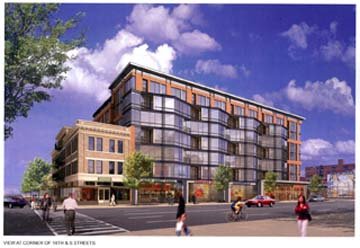
Those of you who are only casual observers of neighborhood development matters may have only a passing notion of the Arts Overlay District. The District guidelines were put in place in order to help direct development along some of the areas' most popular retail strips, including 14th Street, U Street, P Street, Florida Ave. and 7th Street.
What many people likely don't realize is the extent to which Arts Overlay guidelines affect projects and overall development along neighborhood commercial corridors. For instance, consider the new JBG Cos. proposal for the Whitman-Walker Building at 14th and S streets. According to Arts Overlay guidelines, only 25% of the retail frontage in the district can be businesses classified as restaurants. With the high number of restaurants along U, P and 14th streets, the neighborhood is currently sitting at around 24%--meaning that the W-W development would be precluded from introducing any new restaurants tenants in the development. This is unfortunate, because the restaurants are thriving in the area and are largely responsible for the continued growth and viability of Logan/U Street as a "destination" for others throughout the region.
At a recent Dupont Circle ANC meeting, the commissioners voted to withhold support of the project, due in part to objections from "local business advocate" Andrea Doughty, who voiced concern about the potential for restaurants occupying space in the new development. Ms. Doughty stated her belief that "eating and drinking establishments" have a greater impact in the neighborhood, and assigned to them the blame of "driving up rents" for other businesses.
Well, there are a couple of ways to address this. First of all, I believe it's possible to embrace the spirit of the law ("we don't want 14th street to be overrun with restaurants") while not embracing the letter of the law ("given the current situation, exceeding the 25% restaurant barrier might not be inappropriate"). I would agree to some extent with Doughty's feelings that restaurants have a greater impact on the neighborhood than other businesses, but that works out in both good and bad ways. My guess is that people such as Doughty are focusing largely on the negative impact: increased traffic, parking problems, noise, etc. But the positive impacts--encouragement of development, increasing the vibrancy of the retail corridor, improving the quality of life for area residents--are just as, if not more, important.
The District's zoning laws already largely prohibit the opening of retail establishments like restaurants and bars in residential neighborhoods. Contrast DC with, say, Baltimore, where you'll find numerous restaurants, pubs and markets scattered about residential areas. To then go a step further an make the opening of a restaurant in an area *known* for restaurants and nightlife more burdensome seems antithetical to the spirit of the Arts Overlay.
In addition, the Arts Overlay guidelines specifically address restaurants, but leave other businesses--such as furniture stores--out. Now, nothing against the "furniture row" that has developed along 14th street, but there is something terribly wrong if JBG receives more encouragement from community development voices to introduce another furniture/housewares shop to the 14th street mix, but not a new dining establishment.
Finally, as to restaurants being largely responsible for driving up the cost of rents in the area--I don't buy it. Perhaps some businesses have seen their rents rise as the 14th street corridor has become more popular and filled-out, but any honest assessment of the neighborhood retail scene would lead one to the conclusion that the presence of the restaurants and bars in the neighborhood have done far more to ENCOURAGE the patronization of other neighborhood businesses rather than do drive them out of the neighborhood. (And does anyone honestly want to argue that the arrival of, say, Cafe Salsa will have a greater impact on neighborhood rents than Bang & Olufsen, Mitchell Gold or Room & Board?)
In progress, it's inevitable that some businesses won't make it or will be forced to move elsewhere. This is unfortunate, but should not be an overriding concern when making decisions about developments that will have an impact on the neighborhood for years to come.
Everyone can agree that a diversity of retail establishments is beneficial to the neighborhood's overall health, but adhering to a set of principles for their own sake--or allowing development to be thwarted on the basis of such protests--serves no one.